
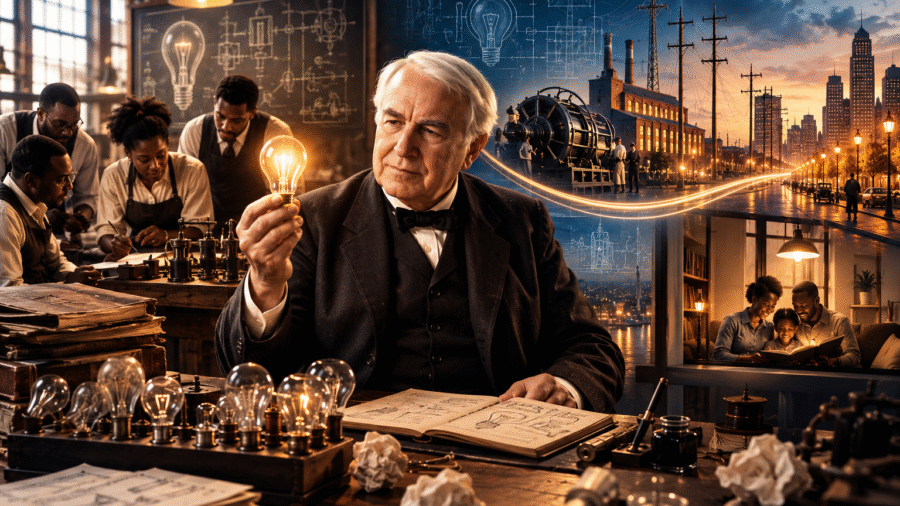
There is something fascinating about the way progress happens. It is rarely a straight line. It is often messy, filled with trial, error, persistence, and moments of insight that quietly change everything. Few people capture this journey better than Thomas Edison, a man whose life continues to shape how we think about invention, innovation, and change.
Thomas Edison is often remembered for the electric light bulb, but his story goes far beyond a single creation. He held over a thousand patents in the United States alone, touching everything from sound recording with the phonograph to motion pictures and electric power systems. What stands out is not just what he created, but how he approached the act of creating.
Edison did not rely on sudden bursts of brilliance. Instead, he worked with discipline and structure. Many people are surprised to learn that he did not actually invent the first light bulb. What he did was take an existing idea and improve it until it became practical, reliable, and affordable. He focused on making things work in the real world. That is where his strength lay. He understood that an idea, no matter how clever, only matters when it can be used.
This thinking naturally led him into something even more powerful. At Menlo Park, he built what many consider to be the first modern research laboratory. It was not just a space for thinking. It was a place where teams worked together, tested ideas, failed, learned, and tried again. In doing so, he quietly shifted invention from an individual effort into a shared process. Today, when we speak about research and development in companies, we are echoing a model he helped create.
As his work grew, it became clear that invention alone was not enough. Edison paid close attention to how his ideas could be applied. When he worked on electric lighting, he did not stop at the bulb. He understood that a bulb without power is meaningless. So he went further. He helped develop generators, power stations, and distribution systems that could bring electricity into homes and businesses. He was not just creating products. He was building systems that allowed those products to thrive.
This is where invention became innovation. It moved from being an interesting idea to something that solved a real problem and fit into everyday life. Edison had a simple belief that guided him. If something could not be used or sold, it had little value. This grounded approach ensured that his work reached people, not just laboratories.
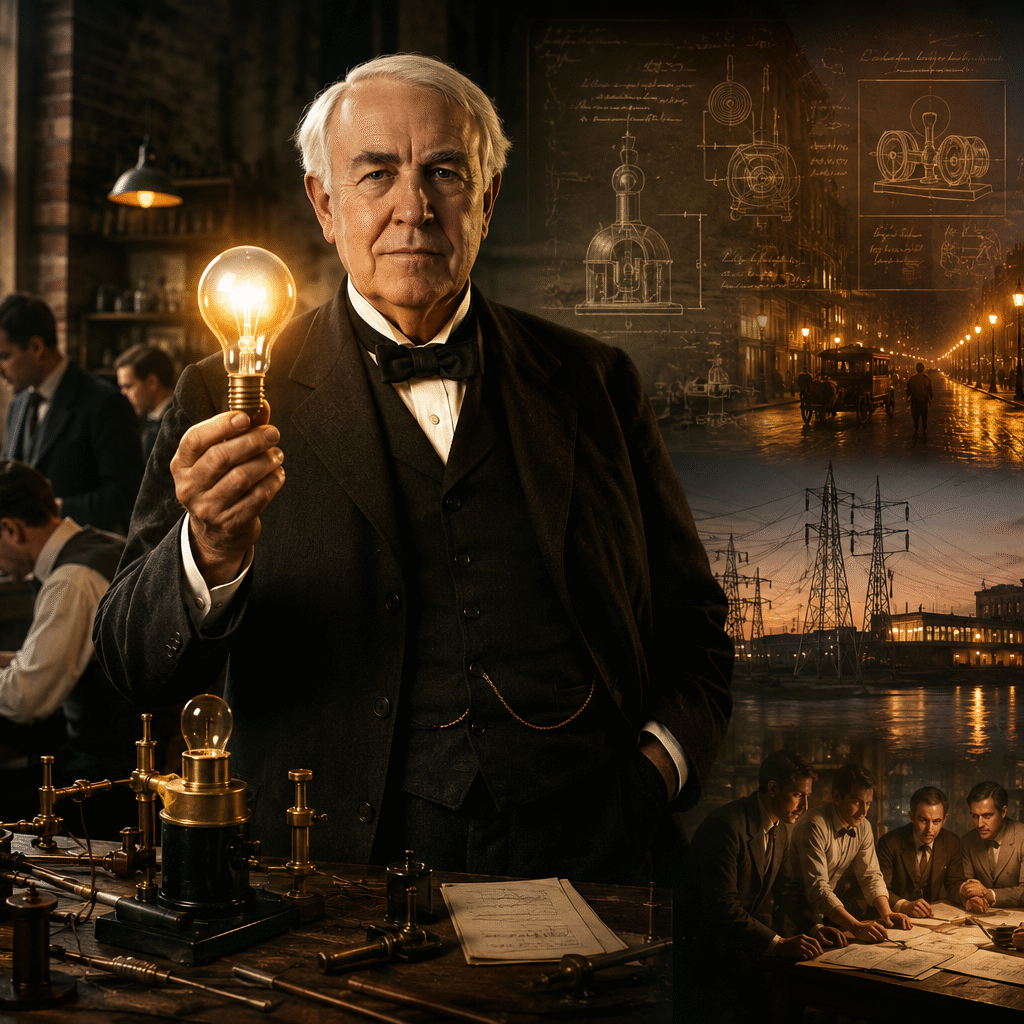
Over time, the impact of his work began to stretch far beyond his workshop. Entire industries shifted. Communities changed how they lived and worked. His contributions played a part in moving the world from a largely agrarian way of life into an industrial one. Factories could run longer. Cities could grow differently. Work and life began to take on new rhythms.
At the same time, he changed how organizations think. By building a structured environment for continuous experimentation, he laid the foundation for how modern companies approach discovery and improvement. The idea that teams come together to test, refine, and develop solutions is now standard practice, yet it traces back to that early vision.
What makes his story even more compelling is how he viewed failure. For Edison, failure was not something to avoid. It was information. Every unsuccessful attempt showed him what did not work and pointed him in a new direction. This mindset allowed him to keep moving forward when others might have stopped. It gave him the resilience to keep refining until something truly worked.
There is a quiet but powerful lesson in all of this. Invention is not always about creating something entirely new. Sometimes it is about seeing potential in what already exists and making it better. Innovation is not just about ideas, but about usefulness and application. Change is what follows when those ideas take root and begin to reshape how people live and work.
For anyone thinking about leadership or growth, there is much to take from Edison’s journey. Progress rarely happens in isolation. It thrives in environments where people can think together, challenge each other, and build on shared ideas. It also reminds us to ask an honest question. Is what we are creating just interesting, or is it truly useful?
And perhaps most importantly, it encourages a different relationship with failure. Not as an end, but as part of the process. A signal to adjust, to learn, and to try again.
In the end, Thomas Edison did more than create devices. He helped shape a way of thinking. A way that values curiosity, persistence, collaboration, and practical impact. It is a way of thinking that continues to guide invention, fuel innovation, and drive meaningful change in the world today.
Leave a Comment