
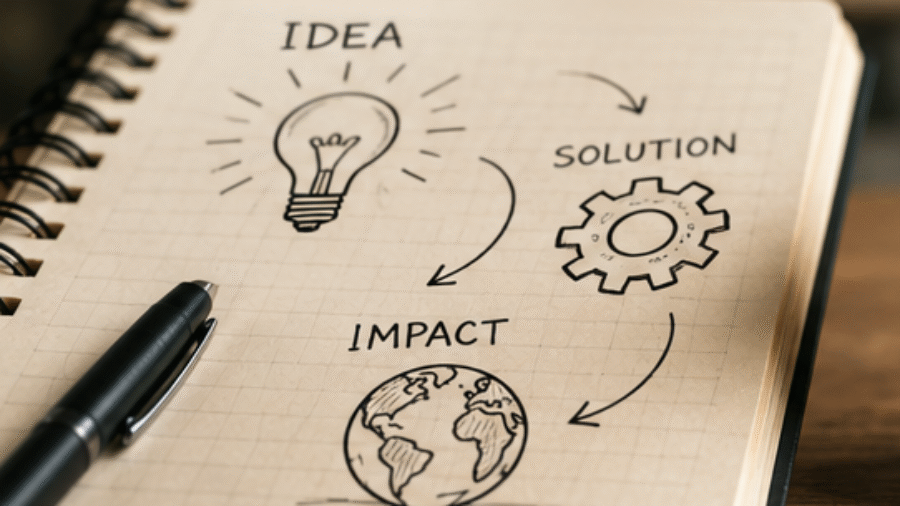
Every so often, someone looks at the world as it is and decides it is not good enough. That single moment of dissatisfaction, whether it happens in a garage, a lab, or someone’s head while stuck in traffic, is where invention, innovation and change all begin. These three words get thrown around so often that people use them interchangeably, but they are not the same thing at all. Understanding the difference between them, and why each one matters, might just change how you look at progress altogether.
Invention: The Birth of Something New
Invention is the spark. It is the creation of something that did not exist before, a brand-new idea, product, or process pulled out of thin air and given form. Think of the light bulb, the telephone, or the printing press. Someone somewhere sat with a problem long enough that a completely original solution emerged.
What happens during invention is often messy and unpredictable. There is a lot of trial and error, a lot of failed attempts, and usually a fair amount of stubbornness involved. Thomas Edison famously tested thousands of materials before he found one that worked for his light bulb filament. Invention does not care about efficiency. It cares about possibility. It is the raw material from which everything else is built, and without it, there would be nothing to improve upon in the first place.
Innovation: Making the New Useful
Once something has been invented, the next question becomes obvious. How do we make this better, or how do we make it actually useful to people? That is where innovation steps in. Innovation takes an existing idea, product, or process and improves it, refines it, or applies it in a new way that creates real value.
Consider the smartphone. Nobody invented the touchscreen, the camera, or wireless internet from scratch when the first iPhone launched. What happened instead was a brilliant combination of existing technologies packaged in a way that changed how billions of people live, work, and communicate. That is innovation in action. It is less about creating something from nothing and more about seeing connections nobody else noticed, then building something meaningful out of them. Innovation often gets the spotlight because it is the stage where ideas finally meet the real world and prove whether they can survive contact with actual human needs.
Change: The Ripple That Follows
Once invention and innovation have done their work, change is what naturally follows. Change is the shift in behaviour, structure, or mindset that occurs as a result of something new being introduced into a system. It can be sudden or gradual, welcomed or resisted, but it is always happening whether we notice it or not.
When the internet became widely available, it did not just give people a new tool. It changed how businesses operate, how relationships form, how information spreads, and even how children learn. That ripple effect is change doing what it does best, reshaping the world around whatever was invented and innovated. Change tends to be the hardest of the three to manage because it touches people directly, and people, understandably, do not always love having their routines rearranged.
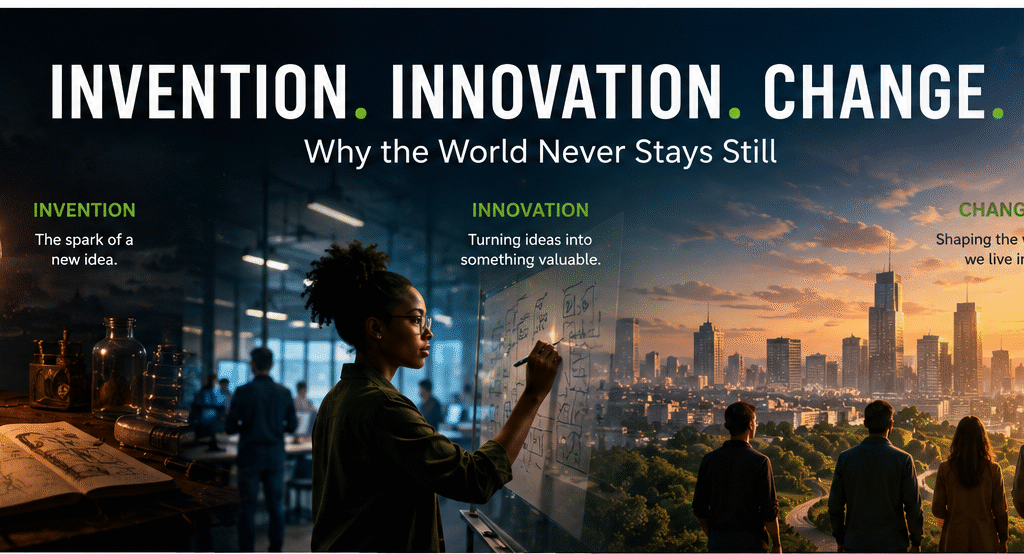
Why We Need to Embrace All Three, Personally and Organisationally
Here is the part that matters most. None of this stay confined to labs, boardrooms, or tech companies. Invention, innovation and change show up in ordinary life too, and how we respond to them says a lot about how far we will go.
On a personal level, embracing these three ideas means staying curious instead of comfortable. It means being willing to learn a new skill even when the old one still technically works, or trying a different approach to a problem instead of repeating the same solution out of habit. People who grow the most in life are rarely the ones who resisted change the hardest. They are the ones who treated new ideas as opportunities rather than threats. Personal growth, career advancement, and even happiness often depends on this willingness to invent new habits, innovate on old ways of doing things, and adapt when life inevitably shifts beneath our feet.
For organisations, the stakes are even higher. Companies that refuse to invent new products, innovate on their existing offerings, or adapt to changing markets tend to fade into irrelevance, no matter how dominant they once were. History is full of examples of businesses that were once household names but failed to keep up, simply because they trusted that what worked yesterday would keep working tomorrow. On the other hand, organisations that build a culture around curiosity, experimentation, and adaptability position themselves to survive disruptions and even lead them. This is not just about staying competitive either. It is about staying relevant to the people you serve, whose needs and expectations are constantly evolving too.
Ultimately, invention, innovation and change are not separate events that happen once in a while. They form a continuous cycle that keeps individuals sharp and organisations alive. The moment we stop inventing, we stop growing. The moment we stop innovating, we stop improving. And the moment we resist change altogether, we risk being left behind by a world that never asked for our permission to keep moving forward.
Embracing all three is not just a smart strategy. It is how progress has always worked, and it is how it always will.
Leave a Comment