
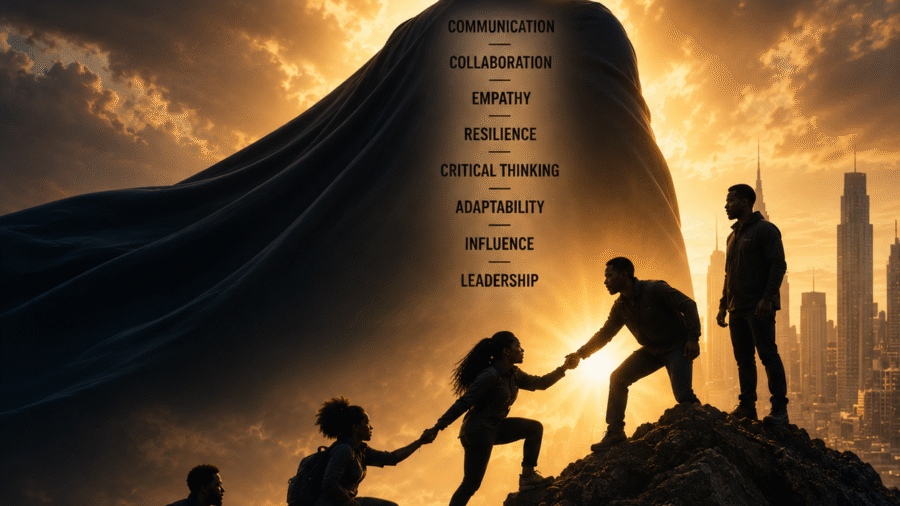
There is a word that has quietly done enormous damage in our workplaces.
A word so embedded in our professional language that most of us have never stopped to question it. A word that shaped budgets, influenced promotions, guided hiring decisions, and told millions of capable human beings that the most profound parts of what they bring to work are somehow secondary.
That word is soft.
And it is time we called it what it is.
How a Word Built a Hierarchy
Language is never neutral. The words we use to describe things tell us — and everyone around us — how much those things are worth.
When we placed skills into two categories and called one of them soft, we did not simply create a filing system. We created a value system. We told organisations where to invest and where to cut. We told individuals what to develop and what to merely tolerate in themselves. We told the boardroom what to champion and what to politely acknowledge before moving on to the real agenda.
Hard skills sat at the top. Technical. Measurable. Defensible in a budget conversation. The kind of capability you could point to on a certificate, test in an interview, or quantify in a performance review.
Everything else — the way a person thinks under pressure, the way they bring a divided team together, the way they communicate so clearly that people actually change, the way they lead not through authority but through genuine human connection — all of that was bundled into the secondary pile.
Soft. Harder to measure. Harder to justify. Easier to deprioritise.
And so we did. We deprioritised it for decades. And we are still living with the consequences.
What the Mislabelling Cost Us
The cost of calling these capabilities soft was not abstract. It showed up in real places, in real organisations, with real human consequences.
It showed up in the technically brilliant manager who could not hold a team together. The one who knew the system inside out but could not have an honest conversation without the room shutting down. The one who was promoted for what they knew rather than who they were — and left a trail of disengaged people in their wake.
It showed up in the high performing team that suddenly stopped performing the moment the pressure increased. Not because they lacked knowledge. But because no one had ever invested in how they think together, how they recover together, how they speak honestly to one another when things get difficult.
It showed up in the talented individual who left — not because of the work, but because of the environment. Because no one in that organisation had ever been developed in the human skills that make a workplace feel safe, seen, and worth staying in.
We built organisations of remarkable technical competence and then wondered why the culture was broken. Why the people were leaving. Why the results, despite all the qualifications in the room, were not what they should have been.
The answer was never in the hard skills. It was in everything we called soft.
A Renaming That Changes Everything
Words matter. And it is time we gave these capabilities a name worthy of what they actually do.
Not soft skills. Power skills.

Not because it sounds better. Not as a motivational rebrand. But because it is simply more accurate. Because when you look honestly at what determines whether a person leads well, whether a team performs, whether an organisation thrives or merely survives — it is not the technical competencies that make the defining difference. It is the human ones.
It is curiosity — the refusal to stop learning, to stop questioning, to stop growing. In a world changing as rapidly as ours, the person who stops being curious stops being relevant. That is not soft. That is survival.
It is communication — not just the ability to speak or write, but the ability to make people feel genuinely heard and understood. To move people. To build trust through words and presence. Every great outcome in every great organisation was built on the back of great communication. That is not soft. That is foundational.
It is critical thinking — the capacity to look past the obvious, question what everyone else is accepting, and make sound decisions when the information is incomplete and the pressure is high. That is not soft. That is leadership.
It is emotional intelligence — the ability to understand what is happening inside you and inside the people around you, and to navigate both with skill and wisdom. Research consistently shows this as one of the greatest differentiators between average and exceptional performance. That is not soft. That is mastery.
It is resilience — the ability to absorb difficulty, recover from setbacks, and keep showing up with clarity and commitment when the environment is anything but easy. That is not soft. That is power.
It is tenacity — the quiet, determined refusal to stop when the work is hard, when the results are slow, when the path is unclear. The people who change things are almost never the most technically gifted in the room. They are the most tenacious. That is not soft. That is the difference.
These are not decorative qualities. They do not sit at the edges of professional excellence. They are at the centre of it. They are the load-bearing walls. Remove them and the entire
structure of performance collapses — regardless of how technically qualified the people inside it are.
The Inversion We Must Make
Here is the uncomfortable truth.
Most organisations train backwards. They invest heavily in technical development and lightly — if at all — in human development. They hire for qualifications and are then blindsided when the qualifications are not enough. They measure what is easy to measure and ignore what actually moves the needle.
And then they call the result a people problem. A culture problem. A leadership pipeline problem.
It is not any of those things. It is an investment problem. We have been chronically underinvesting in the most powerful capabilities available to us — and then expressing surprise when those capabilities are absent.
The inversion is simple to describe and demanding to execute. It requires us to treat power skills with the same intentionality, rigour, and resource we have always given to technical skills. It requires us to hire for them deliberately, develop them systematically, and measure them honestly. It requires us to build environments where curiosity is encouraged, honesty is safe, and leadership is modelled from the top with consistency and integrity.
It requires us to stop crossing our fingers and hoping the human parts will take care of themselves.
They will not take care of themselves. They never did. They need investment. They need championing. They need leaders who believe — not as a slogan but as a genuine operating principle — that the human capabilities in their organisation are not a cost to be managed but a competitive advantage to be developed.
For the Individual Reading This…
If you are reading this not as an organisational leader but as a person — someone navigating their own growth, their own career, their own sense of what they bring to the world — then this is the part I most want you to hear.
The parts of you that someone once called soft are not soft.
Your curiosity is powerful. Your ability to listen deeply and communicate with empathy is powerful. Your tenacity through difficulty is powerful. Your willingness to keep learning when you could have stopped is powerful. Your capacity to bring people together, to create safety in a room, to lead through genuine care rather than positional authority — these are among the most powerful things a human being can offer.
Do not underinvest in them because the world once gave them an unworthy name.
Develop them with the same seriousness you bring to your technical development. Seek honest feedback on them. Find people who model them well and study how they do it. Be uncomfortable in the growing. Because growth in these areas does not come from a
course alone — it comes from practice, from reflection, from the daily decision to show up as a more fully developed human being than you were yesterday.
In an age where artificial intelligence is absorbing technical functions at a pace none of us fully anticipated — the most irreplaceable currency in any organisation is not what a machine can do. It is what only a human can do.
And that begins with you. With the parts of you that were never soft. With the capabilities that were always powerful, even when no one was calling them that.
The Shift Starts Here
We have spent too long apologising for the human parts of our professional capability. Too long treating leadership, empathy, creativity, curiosity, and resilience as the nice section of the appraisal form rather than the strategic priority they have always deserved to be.
The shift does not start with a policy. It does not start with a budget line or a new framework. It starts with a decision — made by leaders, by organisations, and by individuals — to call these capabilities what they have always been.
Not soft. Powerful.
And to start treating them that way. Today. Without waiting for permission.
Because the organisations and the people who thrive in the world ahead will not be the most technically equipped. They will be the most fully human. The most curious. The most resilient. The most capable of leading, communicating, connecting, and growing — through whatever comes next.
That has always been the edge. We just finally have the language to say it out loud.
Leave a Comment