
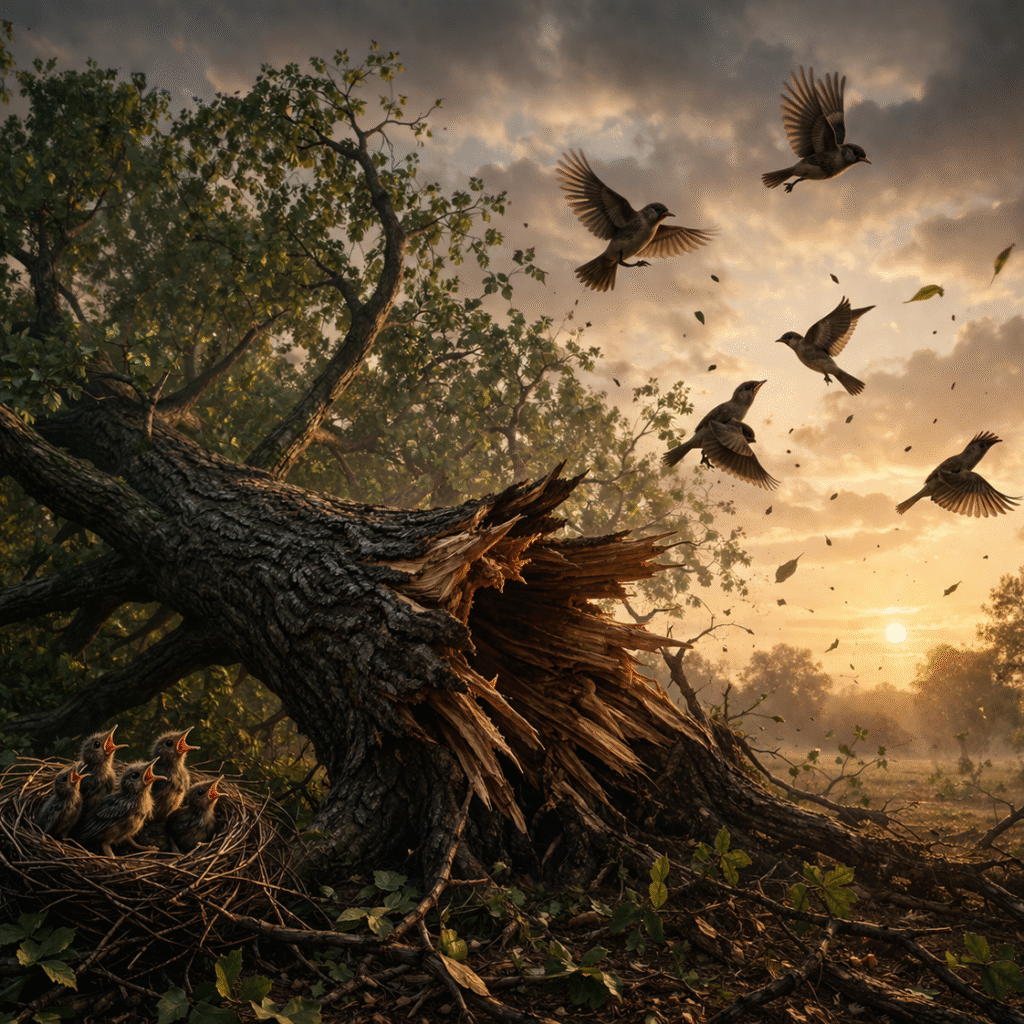
We often find ourselves watching the person at the top. But lately, I’ve been reflecting on something deeper: the shadow they cast.
Mti mkuu ukigwa, wana wa ndege huyumbayumba.
(“When a great tree falls, the young birds are scattered.”)
At first glance, it paints a simple picture—one of trees and birds, of nature moving as it always has. But sit with it a little longer, and you begin to realize this is not just about nature. It is about structure, about influence, about the quiet, often unseen weight carried by those who stand at the centre of systems.
Because in every space where life gathers—whether formed by blood, built on purpose, or sustained by a shared vision—there is always a “tree.”
Not always loud. Not always visible. But present.
It is the one that holds things together. The one whose strength becomes a covering. The one whose stability creates room for others to grow, to build, to rest, to become.
And beneath that covering are lives—watching, learning, leaning, trusting.
So when that “tree” is shaken—by inconsistency, by pressure, by poor decisions, or even by absence—it is never an isolated event. The effect travels. It ripples. It unsettles.
Direction becomes unclear. Confidence begins to waver. What once felt anchored begins to feel uncertain.
That is the quiet truth this methali reveals: stability at the centre sustains life at the edges.
But this wisdom does not end with the one who stands as the pillar. It extends to those who grow under it.
Because wana wa ndege are not meant to remain fragile forever.
They watch. They learn. They are shaped by what they sit on.
And with time, they are meant to grow wings strong enough not only to fly—but to steady one another.
This is where the proverb deepens.
A tree does not stand by height alone. It stands because of what surrounds it and what lies beneath it.
When those being nurtured begin to take responsibility—when they strengthen each other, uphold shared values, and refuse to collapse at the first sign of shaking—the system transforms.
Dependence evolves into interdependence.
Strength becomes shared. Stability becomes collective. And even when one tree is tested, the ecosystem does not fall apart.
Because now, it is no longer about a single pillar trying to hold everything up.
It is about a forest—a forest where roots are intertwined, where growth is intentional, where strength is multiplied across many, not concentrated in one.
This is the shift—from ego to ecology.
Where influence is not about dominance, but about stewardship. Where being “strong” is not about standing alone, but about raising others who can stand too.
So, the question is not just whether the “great tree” is standing.
The question is:
- Are the roots deep enough to sustain it?
- Are those within the branches growing in strength and responsibility?
- And if the winds come—as they always do—will everything scatter, or will it hold?
Because the goal was never just to have one great tree.
It was always to grow a forest.
Leave a Comment